Open House Afternoon 2025
It is past nine o’clock on the night of Wednesday, October 1, and the hall of the Heidelberg Center for Latin America (HCLA), in Providencia, appears almost empty. Yet traces of the crowd that filled the space earlier are still visible: chairs scattered at random, remnants of food on the tables, forgotten papers, and solitary balloons still floating in the cleared space. From the garden come the voices of the last few who resist leaving—the classic scene after a great party.
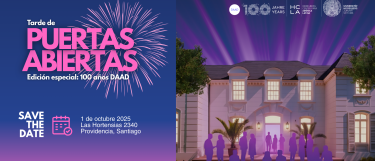
Hours earlier, the HCLA had opened its doors for Open House 2025, the annual event in which the center quite literally opens its doors to showcase its academic life and the collaborations that sustain it. On this day, the atmosphere of classes and study that usually characterizes the University of Heidelberg’s campus in Santiago gives way to the lively buzz of dozens of young people, researchers, and curious visitors who move through its rooms, taking part in talks, German-language games, and stands where dialogue flows in a close and horizontal way with coordinators, partners, and faculty from transnational academic programs. It is a time of reconnection between the HCLA and the people who inspire the joint efforts of Heidelberg University and its strategic partners in the region toward a shared educational project between Germany and Latin America.
This time, the Open House took on a double significance: it also marked one hundred years of the German Academic Exchange Service, the DAAD, highlighting the importance—now more than ever—of striving for a truly cosmopolitan science at a time when tensions between countries threaten to raise new borders. In this spirit, a science slam began midway through the event, in which eight researchers took on the challenge of presenting a topic from their field of study in just four minutes, surprising the audience with questions such as: what lies beneath the sea off Chile’s coast? How do we explain the diversity of planets? Or how does the far right emerge? To these was added the question posed by Fernanda Rokha Sánchez Umaña, who asked what happens when social media cease to be “social” and explained how algorithms have become a structural part of our cognition, our relationships, and even our identity, revealing that the design of these architectures cuts across disciplines and generations.
With creativity and a sense of humor, the eight participants succeeded in breaking down the barrier between specialists and the general public, demonstrating that curiosity and knowledge can be shared with the same passion with which they are discovered.
The celebrations were also joined by the German Ambassador to Chile, Ms. Susanne Fries-Gaier, who opened the science slam with an emotional address, highlighting the significance of the work carried out by institutions such as the HCLA and the DAAD: “They contribute to understanding between peoples and help us build those houses of knowledge that withstand the passage of time. That is why this event is not just a celebration. It is an invitation to continue building together.” The close of the science slam gave way to the final gathering in the garden. Amid laughter and toasts, the constant movement of chairs, the food that disappeared as soon as it was replenished, and the balloons that continued to float, a joyful, intense day came to an end—one filled with hope for collaboration and research among equals.


